№ 02 · Short story
Tales of Koschei the Deathless as a Myth of the Creation of the World
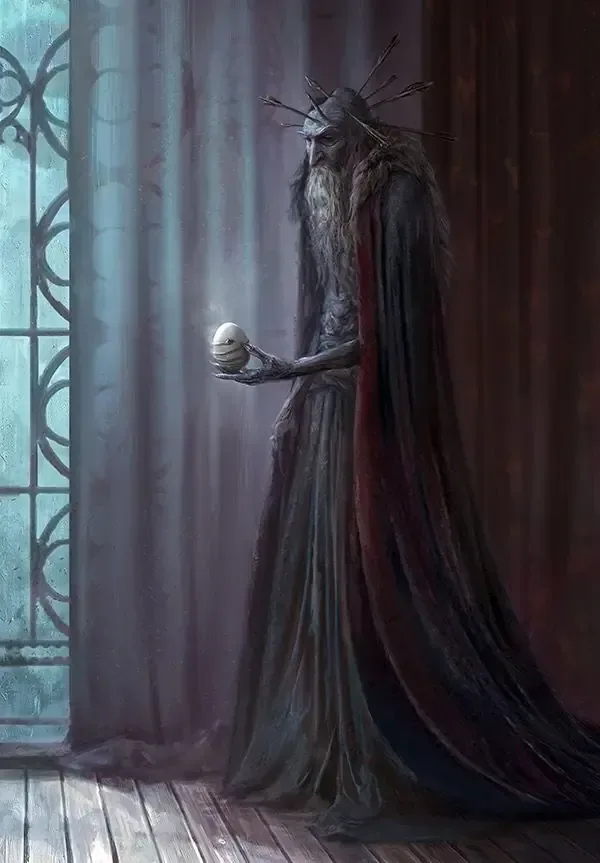
As some psychologists like to repeat, the unconscious is the religious. One could say that for a person living in a desacralised society, religion becomes "unconscious": it rests in the deepest layers of their being, but that does not mean it has stopped performing an important function in their psychic life. Myth was humanity's first attempt to understand and explain the surrounding world and its own place in it. In this essay we will look at what our ancestors believed and what meanings lie hidden in our folk tales about Koschei the Deathless.
Since human beings possess the ability to create symbols, everything they create is symbolic in nature. Here is what Mircea Eliade, the scholar of mythology and religion, writes in "The Myth of the Eternal Return": "As a formula, myth is never belated, but its content is always archaic and always relates to the mysteries, that is, to acts that presuppose the existence of an absolute reality lying beyond human existence."
The figure of Koschei the Deathless, though mythological, can be connected with the historical, cultural and worldview archetypes characteristic of the ancient Slavs and their ideas about the world. His "historical hypostasis" reflects not a particular person but a composite image rooted in certain realities and symbols. The name "Koschei" (also found as Kaschei or Kosh the Deathless) may come from the word "kost" (bone) or "koshchny" (old, frightening, emaciated). This links him to the image of withering and nearness to death. In pre-Christian Slavic mythology Koschei may have embodied the forces of destruction associated with the ebbing of life — winter, hunger or decay.
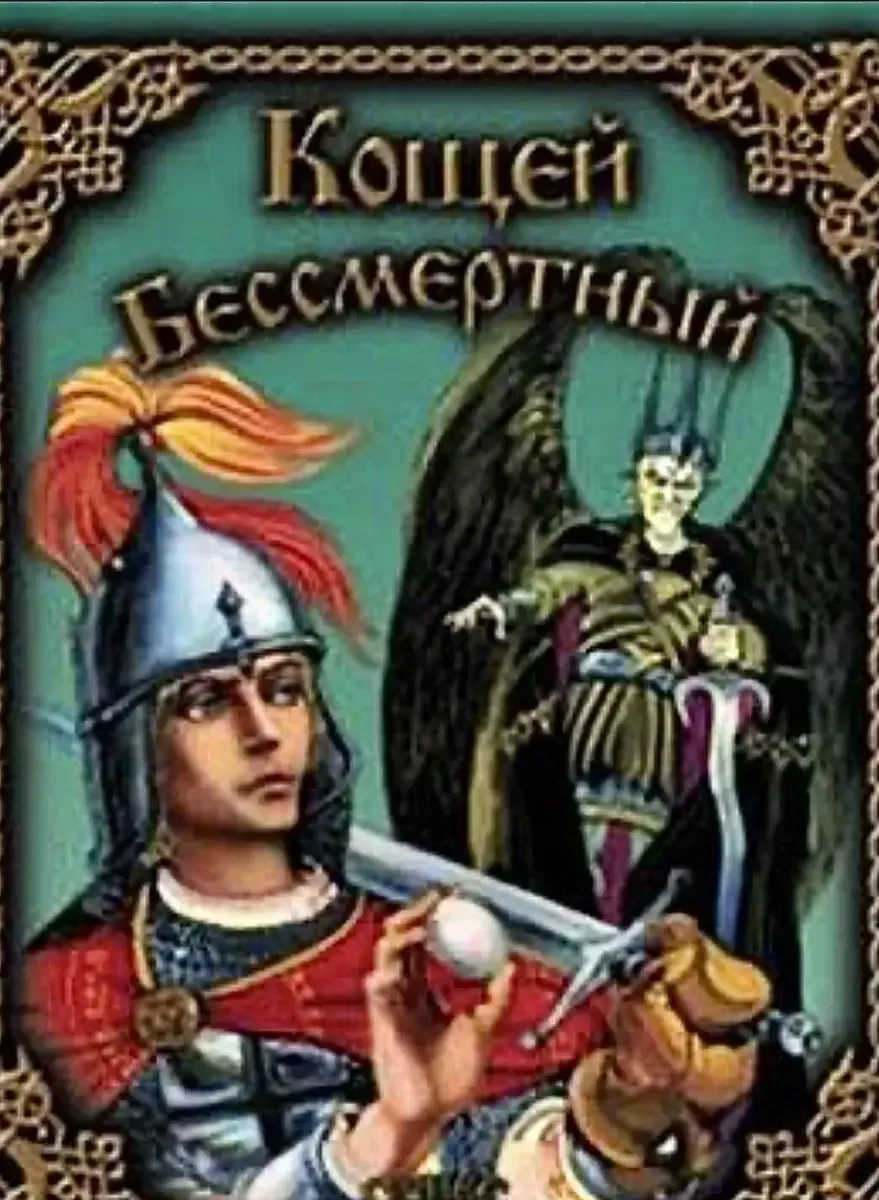
Let us look at some archaic Russian words: koka, koko — egg; kokosh — a brooding hen; kokoshnik — a headdress resembling the comb of a rooster or hen; kokish — the first, well-formed feathers of a goose's wing; kokot' — to strike, to break; koshanok — a swallow, a large flock of birds; kosh — a koshnitsa, a basket; a wicker hut, a booth; a pen, and more generally: an encampment, a halting place, a camp, a settlement, a Cossack wagon train, a bivouac, a nomad camp. Among the Zaporozhian Cossacks a kosh was a settlement, a stanitsa (camp), and the koshevoy was the head of the kosh, the stanitsa ataman. Gold-washers in Siberia called a kosh the trough or pipe used to send gold-bearing sand down onto the sluice table; koshma is felt made from sheep's wool.
What does Koschei do in the tales? He abducts and holds captive Vasilisa the Wise — who, incidentally, is his own daughter in "The Frog Princess" — Marya Morevna (whose name means "of the sea", that is, connected with water), the hero's mother, and sometimes nameless princesses. Within this interpretation Koschei is held to be the demon of Winter. That is why in the tales he appears as a malevolent old man, personifying everything dark, unsightly and outlived — like the departing winter. The treasures he wastes away over are those very streams of water, personified by Marya Morevna, which he has locked in icy chains; the coming of Spring; and the sun ("wasting away over gold" — gold was associated with the Sun, the metal of the gods) can be read as the abducted bride and the light of knowledge, Vasilisa the Wise, whom the demon of winter has, as it were, hidden in his castle (beyond the clouds) until she is set free by the thunder god (who is also Ivan, or simply a bogatyr, a hero).
In the tale "Yarilo and Kaschei" we are told that Koschei is a mighty god: "Then the menacing storm clouds gathered, the birds scattered across the sky, the beasts fled through the forest, the fish dashed about the sea. And then Mother Damp Earth gave birth to a god both mighty and cunning — the son of Viy, Kaschei the Deathless."
Elsewhere in the same tale:
"The ploughman answered him: (the tiller)
– May heavenly Rod help us! Tell me, mighty god, how are you called? Where are you bound across the open field?
And Kaschei answered him with these words:
– I am the son of Earth and of Viy of the underworld, and everyone calls me differently: some call me Kaschei the Deathless, and others Kaschei Tripetovich. I ride at my mother's bidding to collect tributes and duties from her lands. Ah, you ploughman, good ploughman! Ride with me as my companion!"
That is, the tale speaks of heavenly Rod, of the underworld, and of the manifest world where the action itself unfolds — precisely the Slavic belief in three worlds (Nav, Yav and Prav). Here Koschei is called Kaschei and his patronymic is Tripetovich; in other versions it is Trepetovich. I consider the second variant more fitting, from the word "trepet" (dread), meaning that he struck fear into people.
Koschei is called the Deathless, but in fact he can be defeated if you know where his death is hidden. Here is what Baba Yaga tells Ivan Tsarevich:
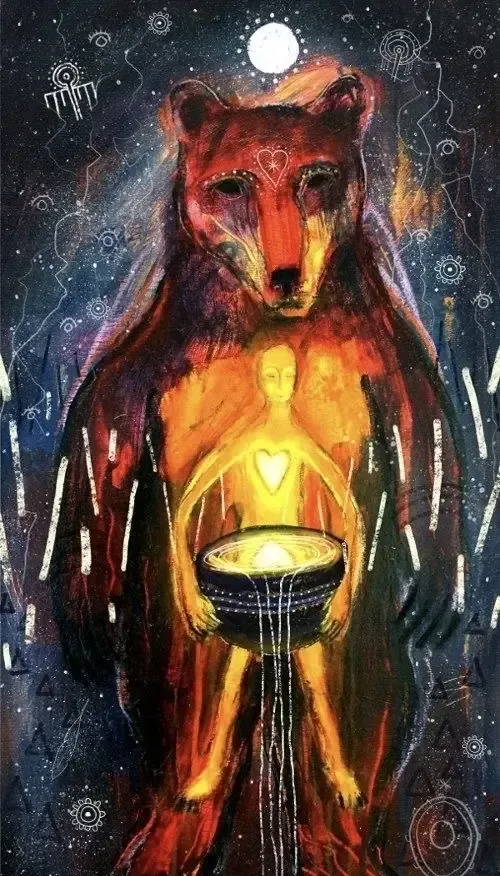
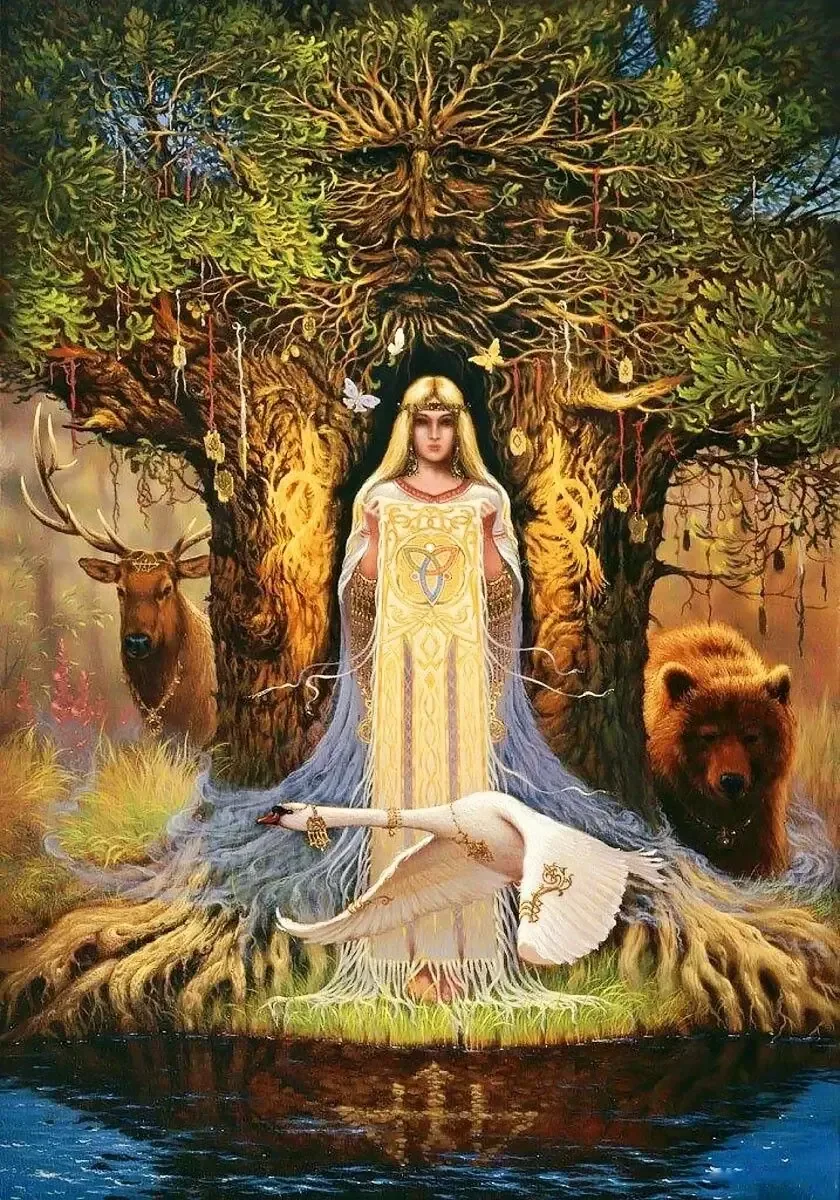
"His death is at the tip of a needle, the needle is in an egg, the egg is in a duck, the duck is in a hare, the hare is in a chest, and the chest stands at the top of a tall oak, and Koschei guards that tree like the apple of his eye" ("The Frog Princess"). In some versions of the tale a bear also sits in the chest, and the hare inside it, and so on, but in most tales the bear comes running and tears the oak out by its roots. Let us consider these meanings: the tree (the oak) and the animals (and the bird — the duck) that turn out to be "nested" one inside another. What does the oak mean to the Slavs? "When the light was born, the oak fell down, and there it lies to this day" — this image unites the different coordinates of the world: the vertical (the tree reaching from earth to the heavens) and the horizontal (the road). Here we are dealing with the World Tree, a mythological archetype, the cosmic tree that unites all spheres of the universe. Characteristic, too, is the motif of felling the tree — just what we see in the tales when the bear brings down the oak — found in Slavic koliadki (carols) in connection with laying bridges for the passage of Ovsen, the New Year, or Christ; a Bulgarian carol gives the world tree's "self-description":
I myself, mother, am a golden tree.
A golden tree, a fruitful one,
That grows right up to the sky,
Lowers its branches right down to the earth,
Opens its leaves like tiny beads,
Puts forth blossoms of white silver,
Bears fruit of pure gold,
So that the young God may come down by me.
— Bulgarian carol
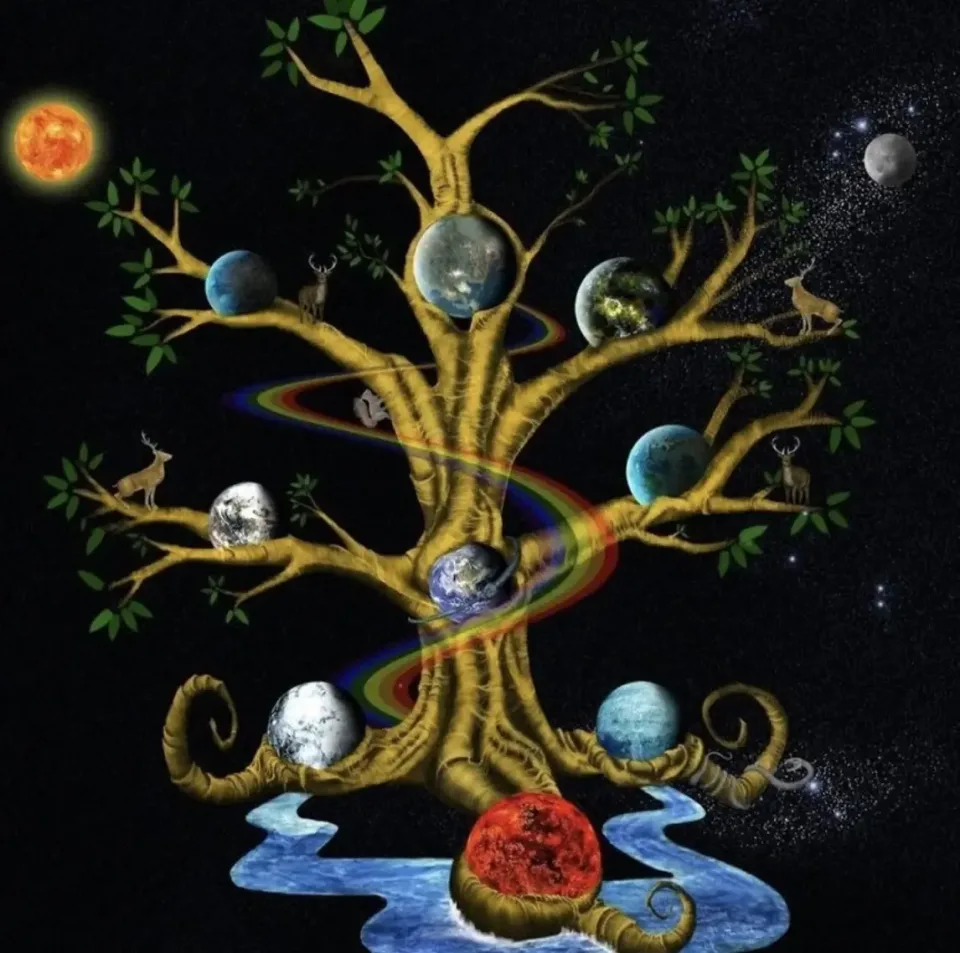
The world tree embodies not only spatial but also temporal coordinates, as the carol motifs cited above attest, in which the world tree turns into a road during the chief calendar (New Year) festival. A Russian riddle says: "There stands an oak, on the oak are 12 boughs, on every bough 4 nests", and so on — speaking of the year, the 12 months, the 4 weeks, and so on. In charms and incantations the world tree is placed at the centre of the world, on an island in the middle of the ocean (the "navel of the sea"), where on the stone Alatyr stands a "damask-steel oak" or a sacred tree — a cypress, a birch (in particular one turned upside down, roots to the sky), an apple tree. In the apocrypha the Lord Himself rests upon the world tree — the tree of life — when He enters Paradise. The symbol is interpreted like this. The trunk of the tree is the Manifest world, Yav. It is the world of the Slavs and, in a philosophical sense, is understood as being. The roots of the tree are the world of Nav, where Morena, Viy and the navi, mythological creatures, dwell. The lush crown of the tree is the world of the bright gods and the Ancestors, Prav or Vyriy, the Higher Iriy, as the Slavs called Paradise.

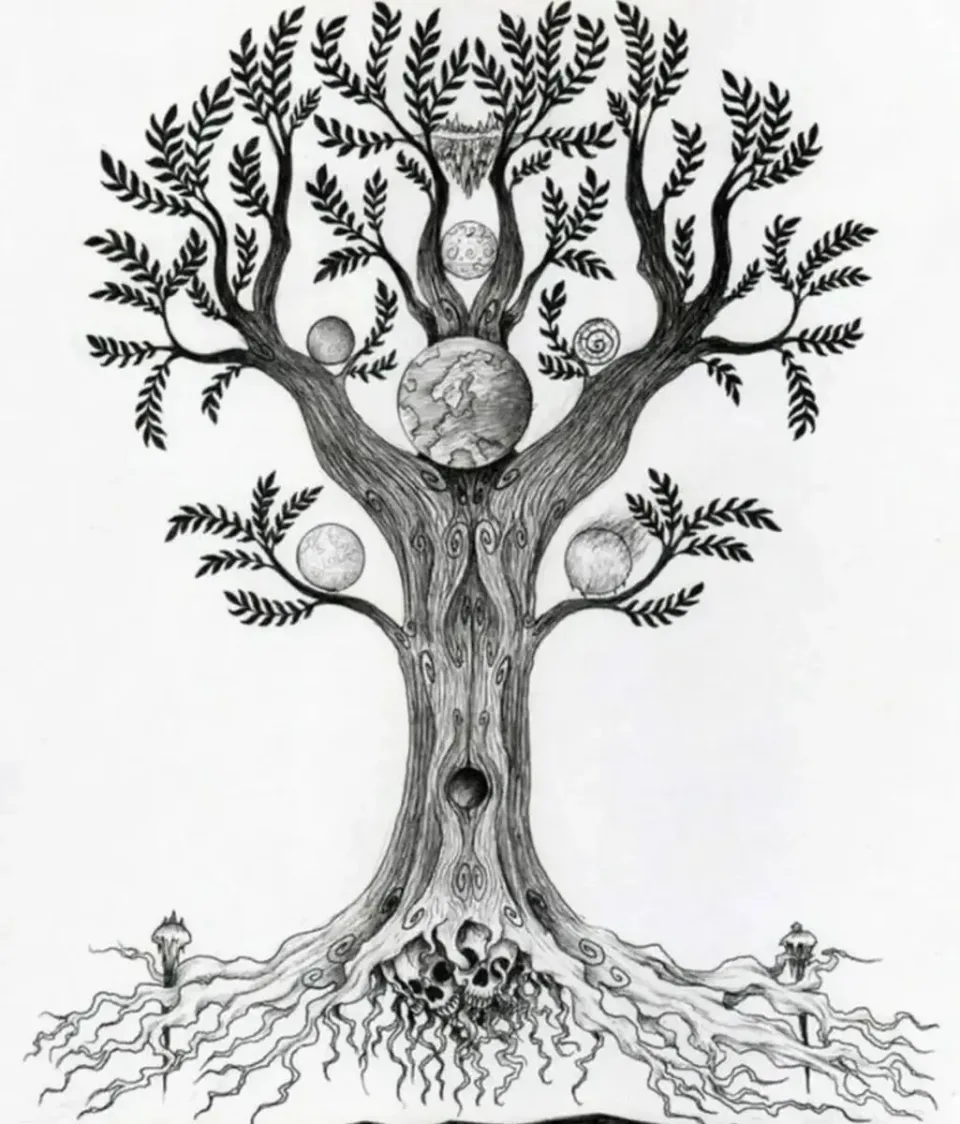
The bear appears in the myths of many peoples of Eurasia and the Americas. In different traditions he could be a deity, a culture hero, a forefather, a guardian spirit, the master of the lower world. The bear's habit of falling into winter sleep (at the Exaltation of the Cross) and waking in spring (at Maslenitsa or the Annunciation) became the key fact in seeing the bear as an analogue of Dazhbog, who locks up winter and unlocks spring. In Slavic beliefs the bear was at various times considered a kinsman of humans (because of his ability to walk on his hind legs, climb trees and eat the same food as people, and also because of the resemblance of a bear's paws to human feet and toes).

The bear's true name was forbidden (just as a god's was); today's word "medved" is a kind of substitute for his real name and means "the one who knows honey", who knows where the honey is. The bear had several dozen such substitute names; among the most common were "himself", "the master", "the black beast", "the shaggy one", "the club-footed one", "the wild-hive keeper", "the old man", "the forest man", "grandad"… The bear's name found in Old Slavic runes, wall and household inscriptions and images sounds like ber or bar (derived from the word for berloga, the bear's den. The city of Berlin comes to mind at once — perhaps it was once Berlon, in the sense of lono, the bosom, the lair of the bear). There is the phrase "medvyany yastva", honeyed foods (honey is the food of immortality in many traditions), so the bear is no longer simply the one who knows where the honey is, but the one who knows immortality.
One ancient manuscript presents a legend that the bear descended from man. Here we can already trace a certain resemblance between the beliefs of the Slavic peoples and the legends of the distant inhabitants of Siberia and of North American Indian tribes, which describe almost exactly the story of an "old man" who turns a man into a bear, after which the bear has cubs and goes off into the forest, far from people. Now and then he returns to people to help some of them. Among different peoples the story changes: the man is not turned into a bear by anyone — he is a powerful shaman who can himself turn into a wild animal during rituals. He liked being in the beast's body so much that in the end he stayed that way and left people, becoming the forefather of bears.
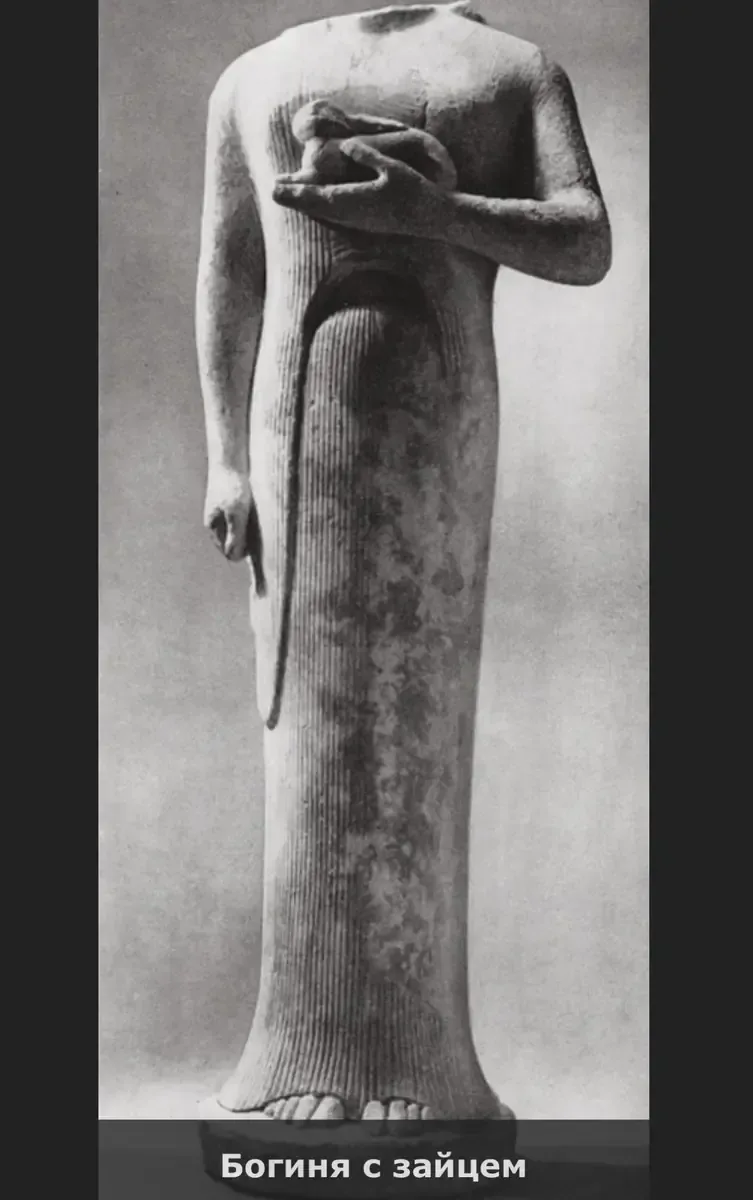
Next in the tale a hare leaps out of the chest. As a symbol of fertility it is an attribute of Aphrodite, an animal of the feminine principle, of the lunar goddess on the one hand and of the underworld on the other, which is metaphorically the same thing. Thus it is associated with the symbolic "harlot goddess" with a black face and long, loose, hanging locks: the hare runs ahead of her, a raven flies above her head, she is wrapped in a net and sits astride a goat, her feet stepping along the ground.
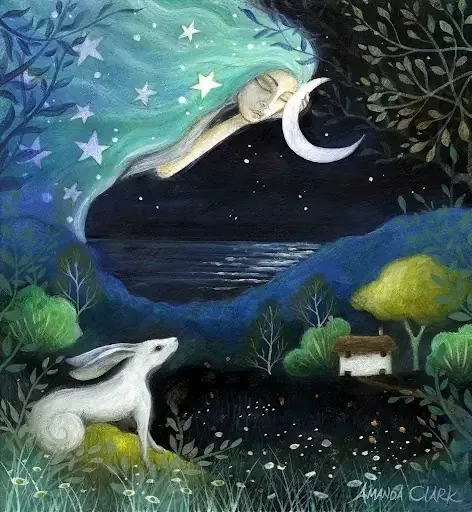
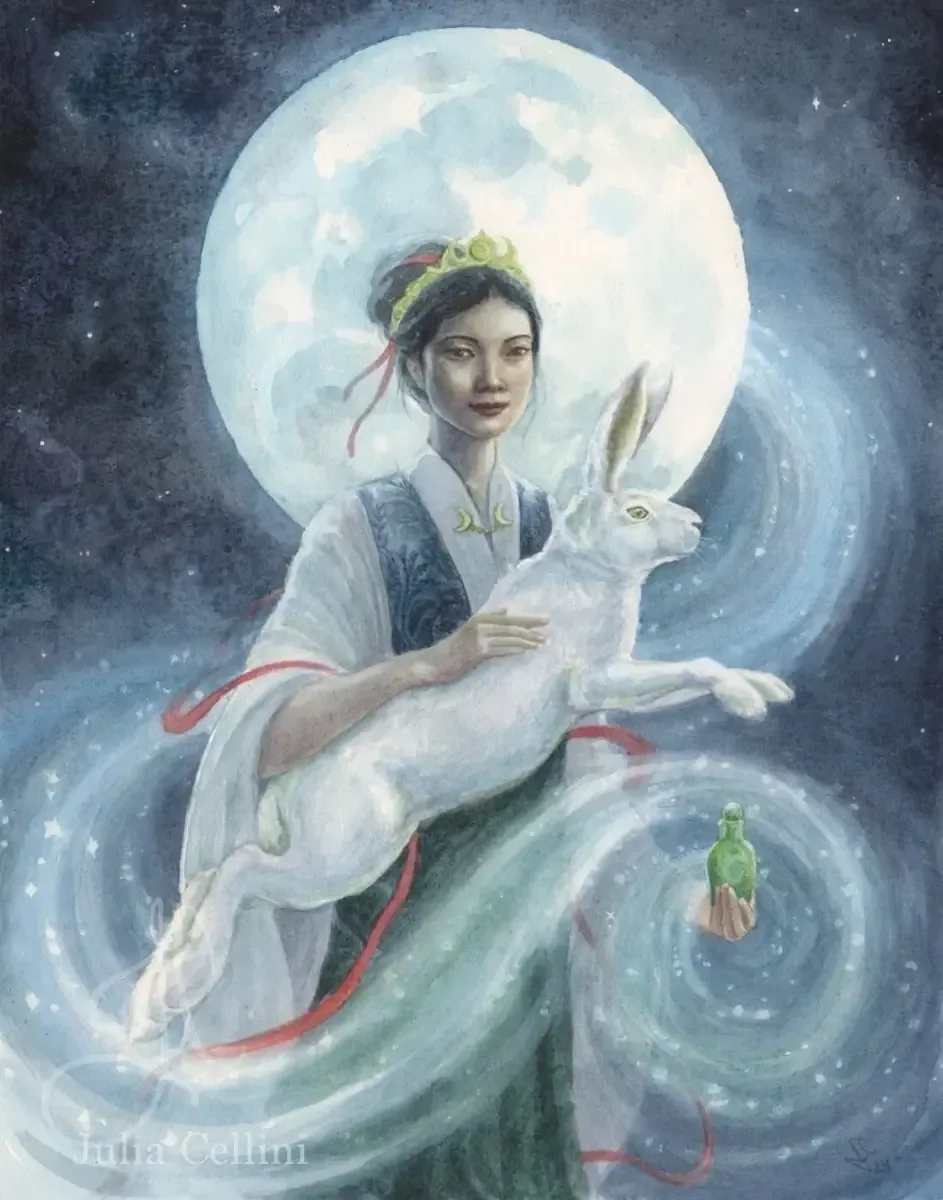
The lunar goddess is also Artemis or Hera, who mark the different phases of the Moon, and whose animal was sometimes the hare as well. In some myths lunar hares live on the Moon. In medieval tradition the hare lays Easter eggs at Easter; lunar women lay eggs too; the goddess Leda found an egg that had fallen from the Moon…
In the tale "Yarilo and Kaschei" we read:
"Then Storm-Yaga seized poor Kaschei and forged him in iron chains, and dragged him into deep caves, and nailed the Deathless One to the wall. She shut him in behind bolts, she locked him up with locks:
– You wanted to sow rye in the open field, to gather it, then thresh it, make malt, brew foaming beer — but that is the work of fiery Yarilo! You shall not see the white light, the white light, the Red Sun!
And Viy's daughter turned Yarilo back from a Hare into a mighty god:
– Where a grey Hare was — Yarilo, arise! Green oak, stand before me, and Yarilo, stand behind me! And all happened at once, according to her word."
— the tale "Yarilo and Kaschei"
So here the tale describes the transformation of the sun god Yarilo into a hare and back again. In Slavic myths the grey hare is a symbol of Krivda, Falsehood, while the white hare is the symbol of Pravda, Truth.
Further along the chain, inside the hare is a duck. It is the symbol of the mother-progenitrix, and among many peoples it is connected with the mystery of the origin of all that exists (in Egypt it is a symbol of fertility; in Sanskrit it is called the lady-duck; and so too in China, among the northern peoples of Russia, and elsewhere). The Komi people regard the duck as a symbol of fertility and well-being. In the mythology of the ancient Finno-Ugric peoples the image of the duck was given enormous significance. According to the story of the creation of the world, the duck brought up earth from the bottom of the primeval ocean, or else laid an egg from which the earth, the sky and the heavenly bodies came forth; in essence, the duck symbolised the cosmic force responsible for the creation of the universe, of a space for human life.
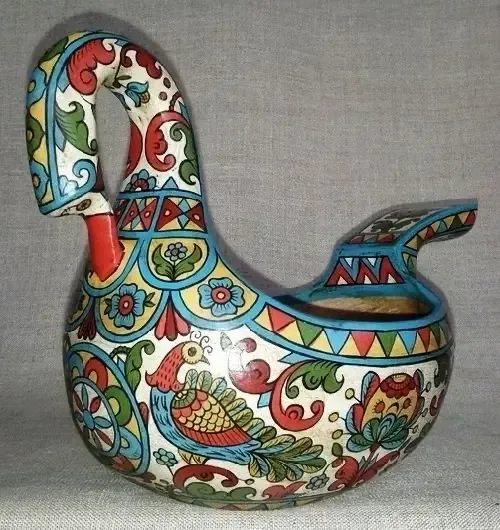
Why was the duck given such a role in the creation of the world?
The Mother Goddess is an image present in every culture in the world, and it is connected with the feminine principle that gives birth to all that exists. In the early stages of human history all of nature was imagined as a female deity — hence her omnipresence: she is Mother Damp Earth, she is the goddess of the sky, of the waters…
She gave life, and she also took it away: to "go to mother damp earth" meant to die.
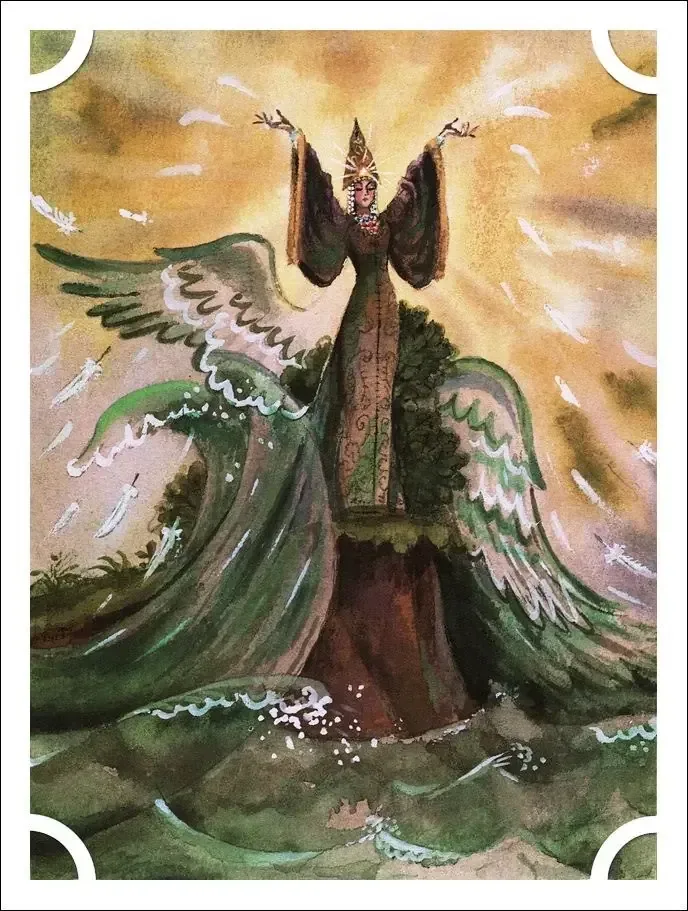
The World Duck was born from the foam of the newborn Ocean. According to legend, it was she who brought up Alatyr from the bottom of the Milky Ocean. The little duck is an Old Slavic symbol of the purifying power of Water. Images of the World Duck have been found in the basin of the upper Kama River. The find dates to the 4th–6th centuries AD.
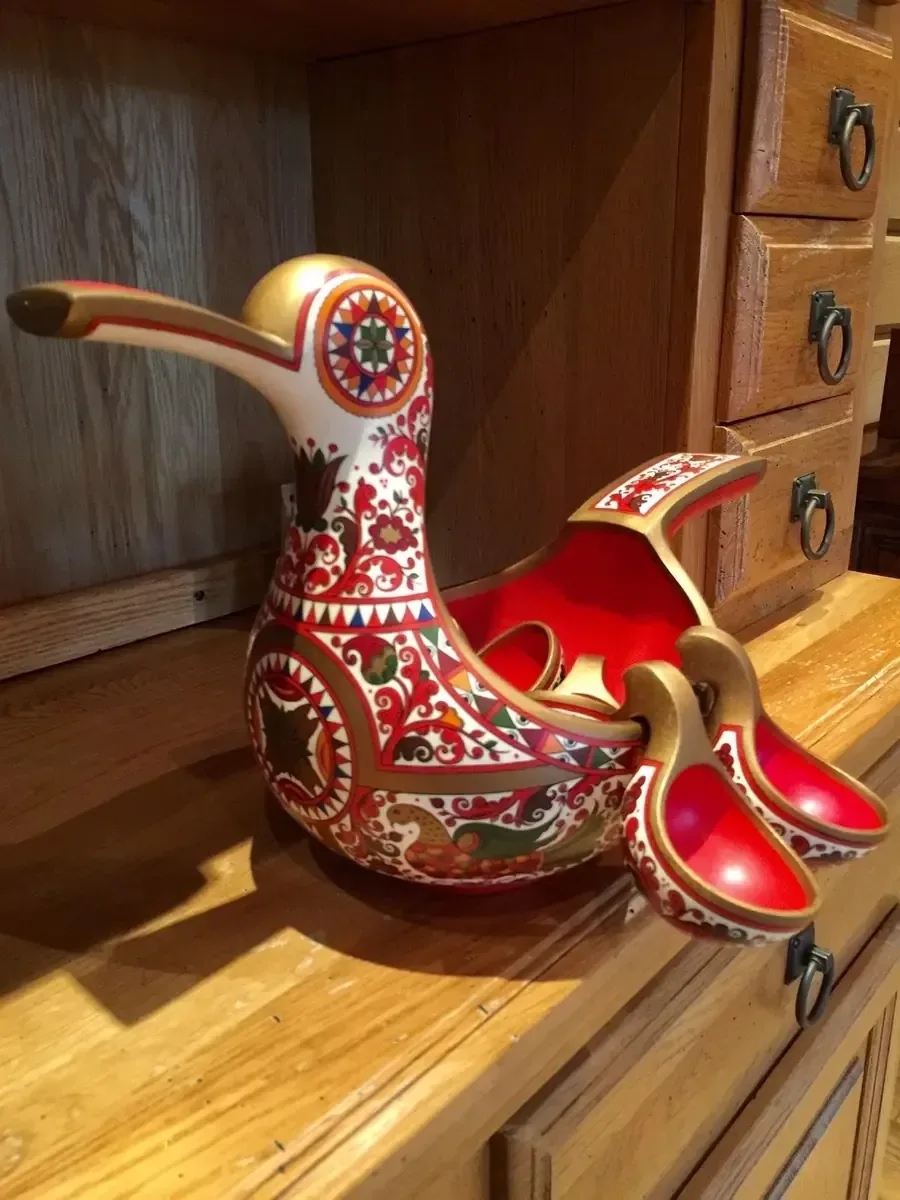
It was the image of this bird that served to explain the birth of all creatures. Our contemporaries still argue, half in jest and half in earnest, about which came first — the chicken or the egg? But for the ancient Slavs, who settled along riverbanks, ducks were at first the more familiar bird — a waterfowl, let us note, and so closely bound not only to the air but also to water. The World (cosmic) Duck laid eggs from which could hatch both bright (good) creatures and dark (unkind) ones. This points to the complete indifference of this divine bird towards good and evil. This goddess brings both the one and the other — both happiness and misfortune — just like another image, perhaps parallel to her, Mother Damp Earth, who, in the ancient Slavs' understanding, could likewise give birth both to monsters and to good creatures. Among the Slavs one clearly senses the cyclical coming of Krivda and Pravda, Falsehood and Truth, upon the earth. That is, the triumph of Falsehood can in principle never be final, and it is always followed by a new turn of the spiral in which Truth and the spirit are reborn. Herein, too, lies the difference between the Vedic and the Biblical worldview: for the Proto-Slavs there simply was no Apocalypse and no end of time; their worldview was built around a conviction in the eternal triumph of Truth, despite its temporary defeats. Such is the myth of the eternal return, of the coming of Spring after a long, cold Winter.
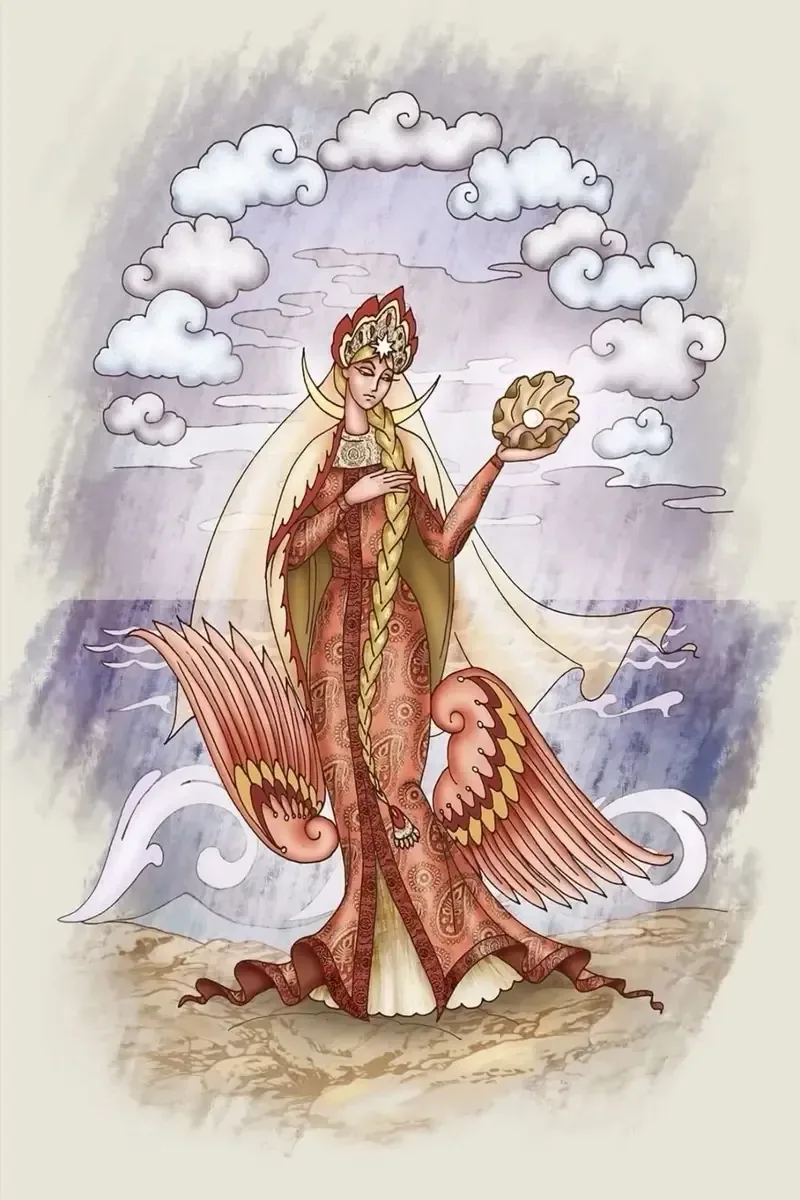
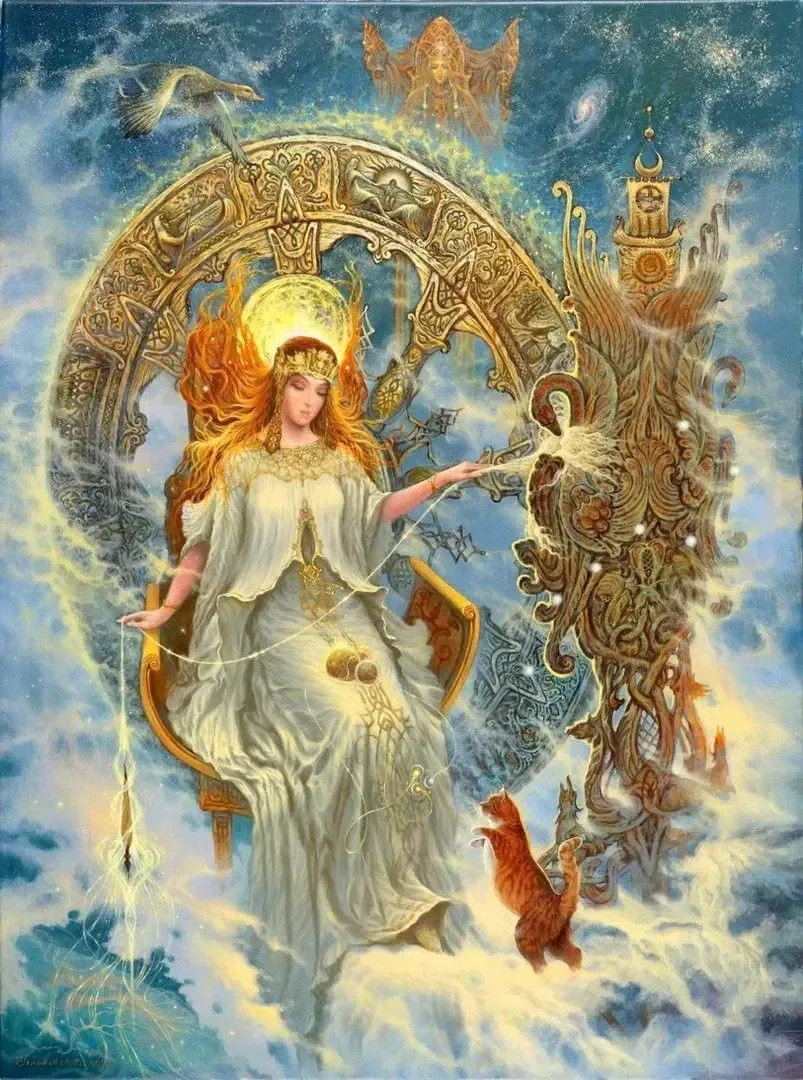
The egg is a symbol of the beginning of the world, of the birth of life; in it everything is fused together, white and yolk, a divine polarity. One Indo-European myth tells that light burst forth from the primordial void and created an egg, and from that egg came the Universe. Another myth relates that the White Light gave birth to an egg from which the First Man emerged. Inside the egg is the needle. What is a needle's direct purpose? To sew, to weave. In the Bhagavad Gita God Himself "weaves" the World. Krishna proclaims Himself the Supreme Being "by whom the World is woven": "All this is woven by Me". And after the dazzling theophany (the glorification of God) of the eleventh canto, Arjuna exclaims: "You are the primal God, the Ancient Spirit <…>, by You all was woven." For a theistic Upanishad such as the Shvetashvatara, "the one God is like a spider, who wraps himself in threads issuing from the primordial Fabric (Matter)". As is evident, the Primordial Weaver finds himself in the same position as the Cosmic Spider: he is likened now to the Sun, now to an impersonal principle (Atman — Brahman), now to the person of God Himself. Yet whatever his nature or the form he chooses for existence, in every context the Creator is a "Weaver" — which means that he holds the threads or invisible strings (cords) by which the Worlds and the beings he has created (or, more precisely, "emitted" from himself) are attached to him.
To be created and to exist in time, to endure, means to be "produced" by the Creator and not to break one's connection with him — a connection embodied, as it were, in a thread. Even when — already in the age of the Brahmanas, but especially in the Upanishads — the main emphasis falls on the need to "join" and unite the actions of the breaths (the winds) in order to mould (to sculpt) an immortal being, the Atman, the talk is constantly of a "process of creation": a means of access to a transubstantial mode of existence is being made, an instrument is being produced by which immortality is attained.
The Sun, the Gods or Brahman "weave" the world. Thus the result of the weaving is inseparably bound to its maker, the fabric to the weaver. The Universe was created by someone, but that is not all: it is tied by threads to its creator. Creation remains bound to the Creator: it is joined to him by an umbilical cord. This matters, because it means that neither the worlds nor the beings are "free", nor can they be. They cannot set themselves in motion of their own will. Life in them is sustained by the thread that connects them to the Creator, to their Author — but he, the Author, depends on these worlds and beings too. To "live", then, means to be "woven" by the mysterious power that wove the Universe, Time and Life, or else to be joined by an invisible thread to the Cosmocrator (the Sun, Brahman, God Himself). In either case, to "live" means to depend on someone else, to be conditioned by them.
The images of the thread and the woven cloth are ambivalent: they reflect both a privileged condition (union with God) and a wretched, tragic one (a person finds himself chained to something, his existence conditioned, predisposed, and so on). In either case the person is not free. But in the first case he lives in constant connection with his Creator, while in the second it is the reverse: he feels himself a prisoner of predestination, bound by "spells" or by his own past (the sum of his deeds).
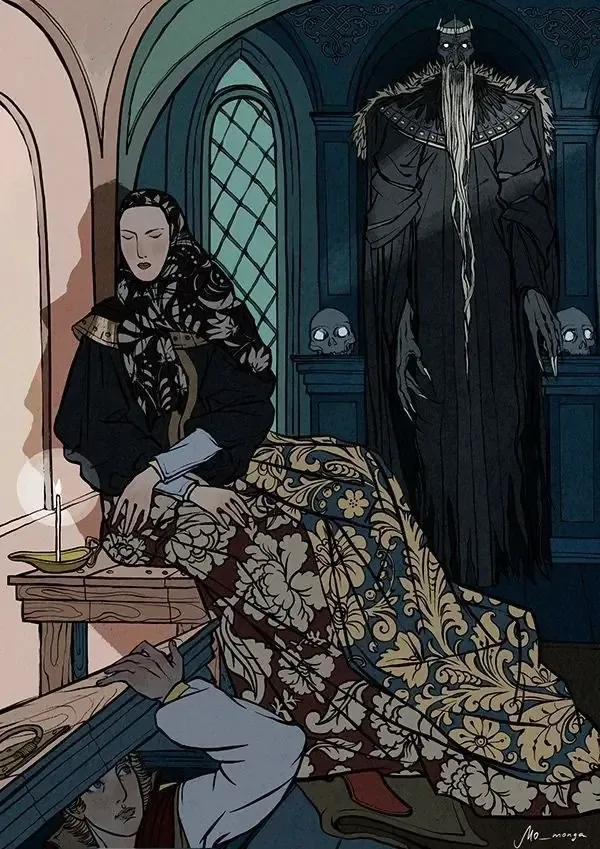
The Hindu Varuna, like Vritra and the deities of death (we are considering Koschei the Deathless), is a "master of bonds": these deities bind and paralyse living beings, they swaddle the dead, and Vritra "fetters" the Waters, as Koschei holds Marya Morevna captive. In these Indian symbols of binding, magical elements predominate: the bound man is paralysed, doomed to death. And indeed, the very same images and formulas of binding and tying can be found in sorcerous rites, in demonology and in the mythology of death. And yet it is precisely Varuna and Indra who release people from their bonds and "give them freedom" (Indra also "frees" the Waters "fettered" by Vritra in the depths of the mountains, just as Ivan Tsarevich frees the princesses — meaning the waters, spring, the sun or wisdom — or his mother, in the sense of matter, from Koschei's kingdom). And in doing so he breaks the needle, as the established order of things.
In the tale "Marya Morevna" there is another version — the hero burns Koschei:
"Whether it took a long time or a short time, he caught up with Ivan Tsarevich, leapt to the ground and was about to cut him down with his sharp sabre; at that moment Ivan Tsarevich's horse struck Koschei the Deathless with its hoof with all its might and shattered his skull, and the tsarevich finished him off with a club. After that the tsarevich heaped up a pile of firewood, kindled a fire, burned Koschei the Deathless on the pyre and scattered his very ashes to the wind." The transforming power of fire — and the horse is a symbol of the sun.
You, holy sun, blaze on!
As this lamp grows pale
Before the clear rising of the dawn,
So false wisdom flickers and smoulders
Before the deathless sun of the mind.
Long live the sun, and let the darkness hide!
— A. S. Pushkin
…what would your good do if evil did not exist, and what would the earth look like if all the shadows disappeared from it?
— M. A. Bulgakov
Absence of evidence is not yet evidence of absence. From that ancient civilisation of the Slavs or Proto-Slavs — the name, I think, is not so important; of our ancestors, in short — no obvious buildings have survived, like the pyramids in Egypt; perhaps it was so long ago that no buildings or structures could withstand such a test of time. Except one. The human being himself, and his language. The Russian language itself preserves the best evidence of that civilisation, which possessed vast knowledge of the order of the world, and that knowledge was encoded in what seem at first glance to be simple children's fairy tales. Our ancestors preserved for us the Living Word, which, in my view, is more precious than any "sacred" stones. The Deathless Mind. Eternal Life. A fairy tale is a lie, but there's a hint in it.
If you copy, please link back.
Comments
No comments yet. Be the first.